Atoll nations like the Maldives stand on the frontlines of the climate crisis. With most of its land less than one metre above sea level and communities dispersed across nearly 200 inhabited islands, the country faces acute challenges in preparing for and responding to climate-induced hazards such as storm surges, coastal flooding, and extreme weather events. These risks are not only environmental but also systemic, affecting infrastructure, livelihoods, and national economic stability. Strengthening coordinated, real-time disaster response has therefore become a critical national priority.
In this context, the Government of the Maldives, through the National Disaster Management Authority (NDMA), with support from the World Bank, established the National Emergency Operations Coordination Centre (EOCC). As the primary client and implementing authority, NDMA has led the development of a centralised system that serves as the nerve centre of disaster preparedness and response. The EOCC marks a shift from fragmented, reactive approaches to an integrated, anticipatory model of risk governance.
Tarutium Global Consulting supported NDMA through a comprehensive technical assistance package spanning digital systems and physical infrastructure. At the digital level, Tarutium designed and developed a centralized EOCC Dashboard that integrates real-time incident reporting, departmental datasets, and historical disaster records into a unified platform. This enables dynamic monitoring, geospatial analysis, and faster, evidence-based decision-making across agencies. Complementing this is a Community Incident Reporting Mobile Application, built on open-source architecture, which allows local responders to report incidents in real time using geotagging and standardised workflows. Designed for accessibility across Android and iOS platforms, the application strengthens last-mile connectivity and ensures that local intelligence feeds directly into national-level response systems.

EOCC Digital infrastructure- Dashboard and Mobile applications
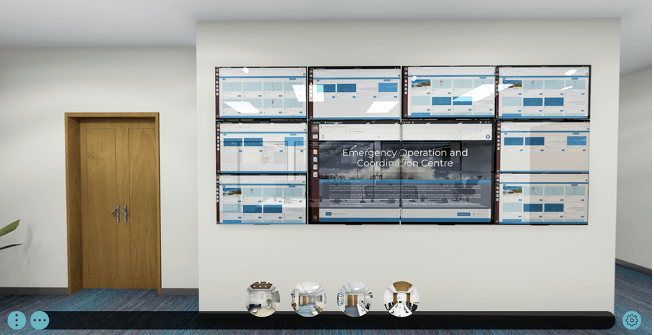
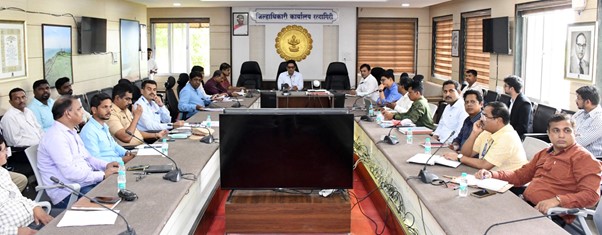
On the infrastructure side, Tarutium led the spatial design and operational planning for the EOCC facility. Given land scarcity, the project adopted a pragmatic approach, refurbishing an existing government building as a Phase 1 operational centre. The facility has been carefully designed with functional zoning for command, coordination, communication, and logistics, along with critical redundancies, including backup power, secure communication systems, and high-resolution visualisation tools, to ensure uninterrupted operations during emergencies.
Beyond systems and infrastructure, the project placed strong emphasis on capacity building. Through training workshops and simulation exercises, Tarutium supported NDMA personnel in adopting, managing, and continuously refining the EOCC ecosystem, ensuring the system remains responsive to evolving operational needs.
What sets this initiative apart is its integrated, scalable design. The EOCC is not a standalone facility but a phased, future-ready model that balances immediate functionality with long-term scalability. By combining digital innovation, adaptive infrastructure, and institutional strengthening, it offers a replicable blueprint for other atoll and small island developing states facing similar vulnerabilities.
As climate risks intensify, the Maldives EOCC exemplifies how targeted investments in coordination, technology, and systems thinking can transform vulnerability into resilience.