

Author: Aastha Kirar, Associate Consultant
Introduction: From Fragility to Agency
India’s shoreline is more than a frontier of land and sea; it is where the country’s climate story is being rewritten. Rising seas, cyclones, and storm surges compound the risks posed by unplanned urbanisation and industrial expansion. At the same time, ecosystems that once buffered communities, such as mangroves, dunes, lagoons, and reefs, remain fragmented and under pressure. National assessments indicate that about 34% of the mainland coast is classified as erosion-prone over the long term.
Policy frameworks exist. The Coastal Regulation Zone (CRZ) Notification, 2019, requires updated Coastal Zone Management Plans (CZMPs) and clarifies permissible activities. The Wetlands Rules, 2017, strengthened governance, and recent programmes, Amrit Dharohar for wetlands and MISHTI for mangroves, signal renewed state commitment. Yet enforcement gaps, mapping delays, and funding silos leave resilience fragmented.
Where progress is most visible is not in ministries, but in shoreline communities, who are turning ecological practice into living governance.
Three forces drive the vulnerability of India’s coasts.
- Hazard: Sea-level rise and storm surge deepen chronic flooding; cities like Mumbai and Chennai already face recurrent compound eventsi.
- Exposure: Urbanisation, ports, and linear infrastructure sprawl into canals, wetlands, and floodplains faster than planning frameworks can adaptii.
- Buffer loss: Mangroves, dunes, seagrass, and lagoons are narrowed, channelled, or hydrologically severediii.
The human case is stark. Odisha’s shift in cyclone preparedness, including mass evacuation systems, shelters, and improved early warning, reduced deaths from ~10,000 in 1999 to 64 during Cyclone Fani in 2019iv. Yet even as lives are saved, asset losses mount without upstream land-use planning and ecological buffers.
From Law to Levers: Finance, Plans, and Flexibilities
CRZ 2019 is often cited as a case study of new flexibilities that ease restrictions on activities in certain zones or clarify buffer distances. However, without safeguards, these flexibilities could lead to ecological setbacks. Every relaxation, such as reducing buffer width in Palk Bay, should be paired with compensatory NbS, ecological equivalence, or mandatory restoration.
Financing is also shifting. MISHTI has brought over 26,000 hectares under mangrove restoration in FY 2023-25, largely through CAMPA and convergence budgetsv. Amrit Dharohar has activated >17,000 Wetland Mitras, 5,800 health cards, and 75,000 ground-truthing exercises, giving wetlands both legitimacy and a citizen-science backbonevi. These schemes create hooks, but the real lever is embedding NbS into city master plans, port environmental frameworks, and municipal capex, while blending in climate finance and CSR.
Grounded Playbooks: Custodians at the Edge
If ministries provide scaffolding, it is communities that are testing the blueprints of resilience. Across India’s shoreline, locally driven NbS demonstrate how ecology, equity, and economy can support one another.
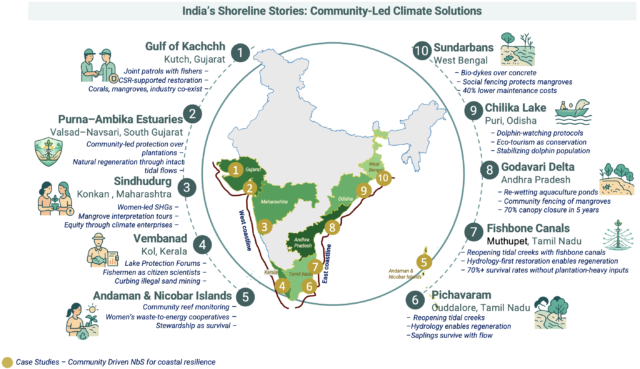
1. Gulf of Kachchh, Gujarat: Layered Ecosystems, Shared Patrols
This industrial-ecological seascape has witnessed coral and mangrove recovery through joint patrols by fishers and Forest Department staff, supported by CSR funds from Deendayal Port Trust. Mangroves, corals, and industry coexist under a co-management model that is scalable and enforceable at the seascape scale.
2. Purna–Ambika Estuaries, South Gujarat: Community-Anchored Restoration of Emerging Mangrove Frontiers
While Gujarat’s mangrove narrative is often dominated by the Gulf of Kachchh, the Purna and Ambika estuaries in South Gujarat represent an emerging and historically under-documented mangrove frontier. Scientific assessments supported by the Mangroves for the Future (MFF) Small Grant Facility identified these estuaries as sites with high natural regeneration potential, driven by favourable tidal regimes and sediment deposition patterns. Rather than plantation-heavy approaches, restoration efforts prioritised community-led protection, restricting grazing and fuelwood extraction to allow natural recruitment to stabilise creek banks and expand canopy cover.
As stewardship norms strengthened, mangroves shifted from vulnerable commons to recognised ecological assets, prompting discussions within Gujarat’s forest and coastal governance system about long-term protection and hotspot designation. The Purna-Ambika case reinforces a critical NbS lesson: where hydrology remains functional, community enforcement, not planting density, determines restoration success, offering a low-cost, scalable model for deltaic estuaries.
3. Sindhudurg, Maharashtra: Women’s Climate Enterprises
Mangrove degradation in the Konkan was met with innovation. The Mangrove Cell and Foundation trained women’s self-help groups (SHGs) to conduct mangrove interpretation tours, manage restoration, and sell fisheries products. Linked to CAMPA micro-plans, these SHGs now reinvest revenues in O&M. Where women’s groups led, canopy cover improved and restoration abandonment declined. Equity became resilience.
4. Vembanad – Kol, Kerala: Governance by Measurement
The 1,512 km² Vembanad-Kol wetland has long faced pressures from invasive weeds, overfishing, and sluice-gate conflicts. Lake Protection Forums (LPFs), facilitated by ATREE, have turned fishermen into citizen scientists who log catches, invasive weeds, and water quality. Their datasets feed into the Kerala Wetland Authority, shaping sluice operations and curbing illegal sand mining. The result: reduced conflict, evidence-based governance, and fishers recast as managers, not just users.
5. Andaman & Nicobar Islands: Stewardship Under Scarcity
In fragile island geographies, stewardship is existential. Community reef monitoring with ZSI and women-led waste-to-energy cooperatives demonstrate how survival and stewardship converge. Protecting reefs sustains fisheries, while managing waste protects beaches and tourism.
6. Pichavaram, Tamil Nadu: Hydrology as Design
After the 2004 tsunami, planting drives failed as saplings withered. Communities and scientists found that hydrology was the first engineer: reopening tidal creeks enabled natural regeneration. Survival rates soared above 70% where hydrological flow was restored, compared with >60% die-off where saplings were planted without tidal exchange. Pichavaram reframed mangroves as dynamic infrastructure, not static plantations.
7. Fishbone Canals, Tamil Nadu: Engineering Tidal Flows for Mangrove Recovery
Mangrove restoration along Tamil Nadu’s deltaic coast struggled where tidal exchange was disrupted. The fishbone canal approach reopened a central creek with lateral channels, restoring salinity gradients and sediment flows essential for regeneration. At sites such as Muthupet, survival rates exceeded 70%, underscoring that a hydrology-first design is crucial for resilient mangrove recovery.
8. Godavari Delta, Andhra Pradesh: Collective Re-wetting
Degraded mangroves from aquaculture were revived by panchayats re-wetting abandoned ponds and enforcing community fencing. Within five years, canopy closure exceeded 70%vii. Hydrology, tenure, and social norms aligned to make restoration self-sustaining.
9. Chilika, Odisha: Protocols That Monetise Protection
Once near collapse, Asia’s largest brackish lagoon has been revived through hydrological restoration and community-anchored dolphin-watching protocols. Co-designed by the Chilika Development Authority and the Wildlife Wing, these rules, which set boat speed limits, stand-off distances, and patrols, have stabilised Irrawaddy dolphin populations while professionalising eco-tourism. Biodiversity has become an economic asset, with incomes rising alongside conservation gains.
10. Sundarbans, West Bengal: Bio-dykes and Social Fences
Concrete embankments in the delta are expensive and fragile. Villages experimented with bio-dykes, planting mangroves on embankment slopes protected by “social fences” against grazing. Maintenance costs fell by about 40% compared with concrete. Regenerative mangroves created fish nurseries and buffered storms. By making protection productive, communities built legitimacy.
Together, these cases form a living climate playbook authored by India’s shoreline communities. They prove that resilience is not a slogan but a measurable practice, scalable, affordable, and legitimate.
Why This Matters: The Triple Dividend
When ecosystems are treated as protective assets, three dividends accrue:
- Avoided losses: fewer disaster damages.
- Unlocked investment: lower background risk encourages development.
- Co-benefits: biodiversity, health, and gender equityviii.
This “triple dividend” lens, adopted by the World Bank and OECD, should anchor India’s coastal budgeting and appraisal frameworks.
Future Pathways: From Cases to Codes
By 2030, India’s coastal resilience might look significantly different if:
- NbS are written into statute books: mandatory NbS chapters in city master plans, port plans, and CRZ clearancesix.
- Blue Resilience Funds emerge: blending CAMPA, municipal capex, CSR, and climate finance to pay for ecological performance, not saplingsx.
- Dashboards make progress visible: a national coastal observatory publishing quarterly shoreline and ecosystem health snapshotsxi.
- Flexibilities carry guardrails: every CRZ relaxation is matched with ecological equivalence.
- Co-management is institutionalised: revenue-sharing committees at Ramsar and NbS sites professionalise guides, waste management, and habitat O&Mxii.
Conclusion: Designing With the Sea
From fisher-led forums in Vembanad to bio-dykes in the Sundarbans, India’s shoreline communities are already prototyping resilience. These are not pilots for donor reports but working models that ministries and financiers can scale. The task ahead is to integrate these defaults into maps, budgets, and contracts, making resilience the baseline rather than the exception. If that shift is achieved, India’s coasts can move from the edge of risk to the edge of resilience.
References:
- MoES. Climate Change and the Vulnerable Indian Coast (2021).
- Chime & Youdon. Vulnerability of Coastal Cities (uploaded doc).
- Dwivedi & Sharma. Sea Level Rise and Coastal Wetlands of India (2005).
- Odisha Government. Cyclone Fani Report; PMC disaster briefs.
- Lok Sabha Question Annex, Jul 28 2025 (MISHTI hectares).
- MoEFCC Wetlands Portal & PIB (Feb 8 2024).
- Adhikari et al. Resilience of Coastal Communities (2021).
- World Bank/ODI. The Triple Dividend of Resilience (2015); OECD (2025).
- WRI India. Mumbai Climate Action Plan; Arup. Coastal NbS Guidance.
- OECD. Financing & Investing in Climate-Resilient Infrastructure (2025).
- NCCR/ISRO proposals for API-first observatory (2024–25).
- MoEFCC/PIB. Amrit Dharohar implementation notes (2023–24).
