

Author: Riddhi Ratnottar, Consultant
In an era dominated by satellites, Doppler radars, predictive algorithms, and real-time dashboards, early warning systems are often seen as technological achievements. Yet in disaster-prone landscapes, the earliest warnings rarely originate in control rooms.
They begin quietly in observation, memory, and lived experience.
They come from elders who remember where floodwaters once reached. From farmers who read shifts in the wind and cloud formations. From drivers who sense unstable slopes before debris begins to fall. From residents who notice cracks in walls or hear rumbling beneath saturated hillsides. These signals constitute what is increasingly recognised as indigenous and local knowledge, a living system of risk intelligence shaped by generations of interaction with the land and climate. As climate extremes intensify, the future of early warning does not lie in replacing this knowledge with technology. It lies in integrating it.
Indigenous Knowledge as Risk Intelligence
Indigenous knowledge systems are grounded in long-term environmental observation, social memory, and lived interaction with local ecosystems. They serve as context-specific interpretive frameworks that help communities anticipate hazards such as landslides, flash floods, storms, and lightning (Hiwasaki et al., 2014). Through generations of experience, communities learn to recognise subtle environmental changes, including terrain instability, rising water levels, shifting weather patterns, and atmospheric variations, which often serve as early indicators of impending hazards.
These systems often detect:
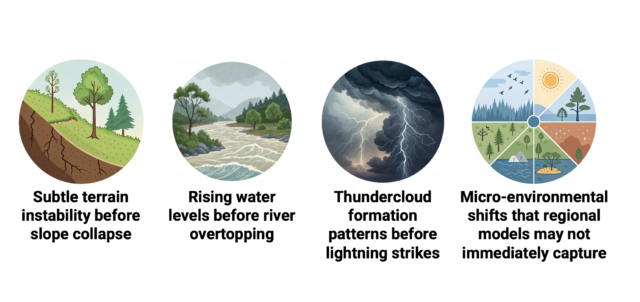
Figure Description: Traditional Signals, Environmental Cues, and Hazard Interpretation: Indigenous knowledge systems identify early warning signs through changes in terrain, rising water levels, storm formations, and seasonal environmental patterns, enabling communities to anticipate multi-hazard risks before formal alerts are issued.
Scientific forecasting remains essential. But disasters frequently unfold through hyper-local triggers. Indigenous knowledge captures these first signals.
Case Insight 1: Himachal Pradesh – When the Hills Speak First
In the mountainous settlements of Himachal Pradesh, communities have long relied on traditional monitoring practices to anticipate environmental risks. A widely recognised example is the stone-marker system, where a marker is placed on a lake boulder to track rising water levels. During a major rainfall event in August 2023, this indigenous practice helped residents anticipate flooding and evacuate before formal alerts were issued. Alongside this, residents closely observe environmental cues such as rumbling from slopes, unusual water movement, and the sudden appearance of cracks in roads and houses, treating them as early indicators of landslides and flash floods.
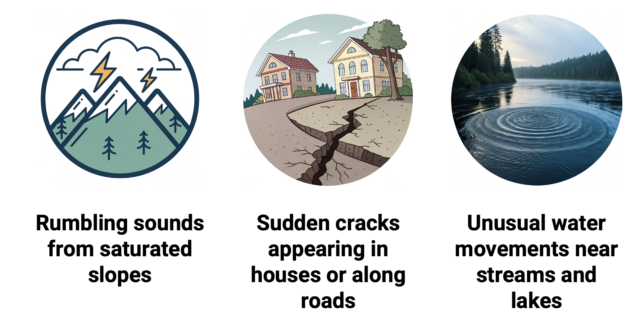
Figure Description: Localised Environmental Signals as Early Warning Indicators: In mountainous regions of Himachal Pradesh, communities interpret thunder activity, ground cracks, and changing water patterns as critical warning signs of landslides, flash floods, and terrain instability.
Despite strong hazard awareness, formal early warning alerts did not consistently reach communities in time, making informal networks such as drivers, neighbours, and local leaders the primary channels of communication during emergencies. In response, the state’s Early Warning and Response System focused on integrating indigenous indicators with formal trigger thresholds to strengthen localised risk detection and response. The framework introduced multi-channel dissemination mechanisms, including SMS alerts, sirens, digital dashboards, and WhatsApp messaging, to improve last-mile connectivity and timely information flow. It also established clear “Alert–Preparation–Evacuation” protocols and defined structured escalation pathways between local bodies and disaster management authorities to ensure a coordinated and accountable response during hazard events.
Case Insight 2: Rohtas, Bihar – Lightning Risk and Behavioural Warning
In Rohtas District, Bihar, lightning poses a sudden, recurring threat, especially to farmers and outdoor workers. Communities anticipate lightning by observing:
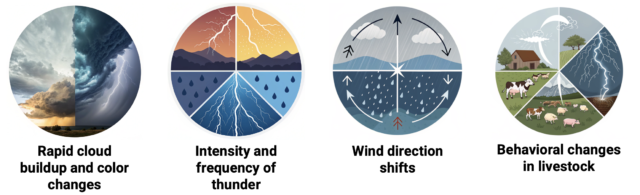
Figure Description: Behavioural and Atmospheric Indicators of Lightning Risk: Communities in Rohtas, Bihar, anticipate lightning events by observing cloud buildup, thunder intensity, wind shifts, and changes in livestock behaviour, demonstrating how local environmental interpretation supports early risk awareness in the absence of timely formal alerts.
However, formal lightning alerts did not consistently reach rural settlements. Access to helplines and structured warning protocols was limited. The Lightning Mitigation Programme responded by integrating meteorological lightning alerts into district-level dissemination systems to ensure timely, verified information reached vulnerable communities. It strengthened multi-mode communication channels to improve last-mile connectivity, installed lightning arresters in public institutions to reduce structural and human risk, and conducted safety awareness campaigns in local languages to enhance comprehension and drive behavioural change. Additionally, tailored training modules were designed for farmers and school communities, focusing on practical lightning safety measures and emergency response preparedness.
The Real Challenge: The Perception-Preparedness Gap
Across both regions, one structural issue consistently emerged: communities possess a deep understanding of local risks and hazard patterns. They know where slopes are likely to fail, when storms intensify, and how environmental signals indicate danger. However, institutional preparedness mechanisms often remain fragmented and disconnected from this lived knowledge. Bridging this gap requires clearly defined institutional roles and escalation workflows, functional local preparedness structures, accessible emergency helplines, regular training and mock drills, and communication systems that operate in local languages to ensure timely understanding and response across vulnerable populations.
From Parallel Systems to Integrated Risk Intelligence
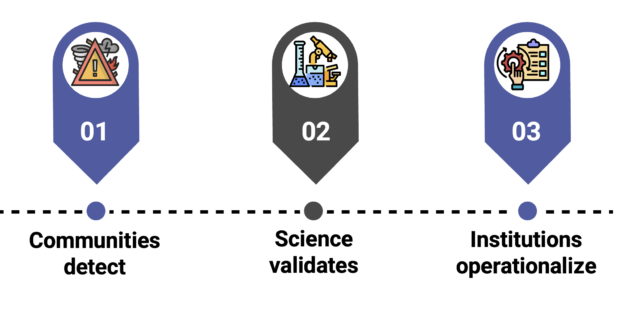
The future of early warning lies in co-production, where community observation, meteorological forecasting, and institutional response systems function as interconnected components of resilience. Research shows that hybrid systems integrating local knowledge with scientific forecasting are not only more resilient but also more trusted by communities (Kelman et al., 2012). Effective integration requires traditional indicators to inform trigger thresholds, while scientific forecasts validate and contextualise local signals. It also depends on disseminating alerts through both digital platforms and trusted local networks, alongside clearly defined institutional responsibilities established before a disaster strikes. When this alignment is achieved, early warning evolves from a communication mechanism into a core component of governance infrastructure.
Conclusion
The future of early warning systems will not be defined solely by faster predictive models or denser sensor networks. It will be shaped by our ability to recognise that the earliest warning is often human-embedded in memory, environmental observation, and lived experience. In mountain regions vulnerable to landslides and floods, and in plains exposed to lightning and extreme weather, the principle remains the same: resilience strengthens when scientific forecasting, institutional systems, and local knowledge work together rather than in isolation.
References
Hiwasaki, L., Luna, E., Syamsidik, & Shaw, R. (2014). Process for integrating local and indigenous knowledge with science for disaster risk reduction. International Journal of Disaster Risk Reduction, 10, 15–27.
Kelman, I., Mercer, J., & Gaillard, J. C. (2012). Indigenous knowledge and disaster risk reduction. Geography, 97(1), 12–21.
Mercer, J., Kelman, I., Taranis, L., & Suchet-Pearson, S. (2010). Framework for integrating indigenous and scientific knowledge for disaster risk reduction. Disasters, 34(1), 214–239.
Sithole, P., & Chundu, M. (2020). Indigenous knowledge systems and disaster risk reduction. Open Journal of Social Sciences, 8, 35–45.
UNDRR. (2022). People-centred early warning systems.
UNESCO. (2021). Indigenous knowledge and disaster risk reduction.
WMO. (2018). Multi-hazard early warning systems: A checklist.
