

Author: Himani Shekhawat, Consultant and Priyank Khare, Sector Head, Urban and Infrastructure
Walking is the simplest way to get around. It is good for health, good for the environment, and it also enhances community well-being. Yet in many Indian cities, walking can be a challenge. From broken footpaths to heavy traffic, several factors shape the pedestrian experience. But what if we shift our perspective, viewing these not as problems but as opportunities for thoughtful and inclusive urban planning?
Indian footpaths serve many roles at once: vendors setting up stalls, cobblers and tailors working at the edges, and residents picking up groceries. These scenes reflect vibrant urban life, where street vendors add cultural, convenience, and economic value. However, vendors are often still treated as unwelcome in public spaces. This is largely due to the presence of unplanned vending areas. When vendors use footpaths, it reduces the space available for pedestrians.
Everyday street life and pedestrian
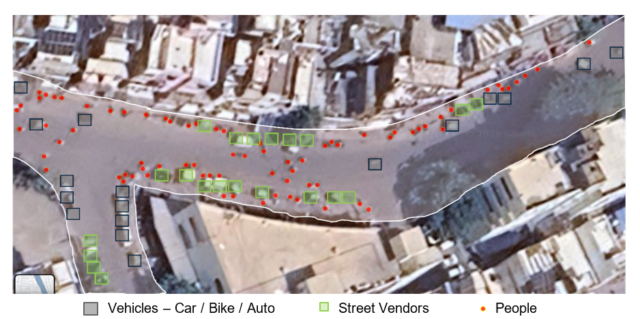
Apart from this, everyday street behaviours include rash driving, two-wheelers climbing onto footpaths to avoid traffic, and cycles or cars parked on sidewalks due to a lack of organised parking. These behaviours have gradually been accepted as normal. In many places, footpaths also become living spaces for people or resting and movement spaces for stray animals. This situation is not only the result of individual choices but also of unclear rules and weak enforcement regarding how spaces should be shared. As a result, walking in public spaces becomes a struggle rather than a way of life.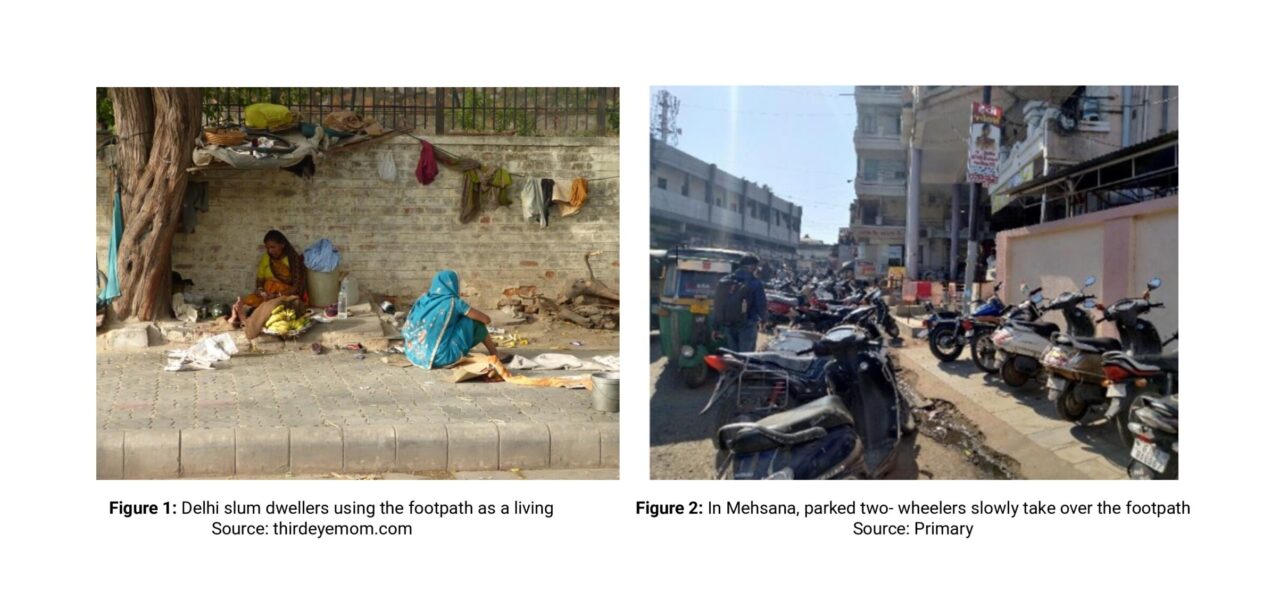 The satellite image below shows a street in Ahmedabad where everyone appears to be sharing the same space. Narrow footpaths are blocked by vendors and utility infrastructure, and pedestrians use the main road alongside moving vehicles. This makes walking unsafe and difficult, especially for vulnerable users.
When Public Space Becomes Private: Example from Delhi
A few studies of Delhi’s posh colonies have shown how public walkways are quietly being privatised. Gates, barriers, potted plants and guard booths are installed on public footpaths, converting them into extensions of private property.
Various studies and observations reflect a pattern:
- Public spaces are treated as an extension of private properties to be claimed.
- Pedestrian rights are negotiable.
- Weak governance enables informal privatisation.
There are other factors that affect the walkability in Indian cities. Even when footpaths exist, they are often hard to use. Many are broken, have sudden height changes or have electric poles placed right in the middle. Lack of visible lighting, open drains, absence of tactile paving and sudden dead ends of the footpath. Streets are mostly designed for vehicles, leaving pedestrians to manage with whatever space is left.
Strategic Framework for Walkable Cities
According to the Association of Municipalities and Development Authorities (AMDA), walking infrastructure must be treated as core urban infrastructure, not as leftover space after roads are designed. Summarising AMDA’s guidelines, walkable cities need interventions at two levels:
- At the urban planning level: Cities need to reduce walking distances by bringing services and amenities closer to people.
- At the street level: Streets must be designed to make walking safe and comfortable.
The Institute of Risk Management (IRM), India, article on ‘a risk-intelligent approach to making Indian cities walkable’ notes that even well-designed footpaths fail to function efficiently if they are not properly maintained or repaired after maintenance works. Authorities should consider maintenance and design aspects such as wider footpaths, clear surfaces, shade provision, lighting, and safe crossing points to support not only pedestrians but also vulnerable communities such as elderly people, children, and PWDs.
Both the AMDA framework and the IRM India approach also give importance to data-driven planning and citizen-centric design. Some key findings from the 2 approaches suggest that:
- High pedestrian movement corridors need to be identified and prioritised
- The interventions should focus on areas of high vulnerability, like streets used by schools, senior citizens, persons with disabilities and daily wage workers who rely on walking for access to work and services.
Recent studies also highlight that pedestrians should be able to walk at street level along continuous footpaths, rather than being compelled to use foot overbridges or subways. Safety should come from controlling vehicle speeds and behaviour, not from shifting responsibility onto pedestrians. Streets work best when space is designed to meet the needs of different users, such as pedestrians, vendors, cyclists, and vehicles, rather than prioritising cars alone.
In our view, the walkability of Indian cities cannot be achieved through small fixes alone. Making walking safe, easy, and pleasant requires an integrated, multidimensional approach that combines street design, governance, data, and advocacy. Moving from concepts to implementation, cities need to adopt a strategy that goes beyond repairing footpaths to address how streets are designed, managed, and protected for pedestrians.
Making Indian cities walkable is not about grand transformations but about everyday choices in design, maintenance, behaviour, and governance that recognise walking as a way of life and of experiencing surroundings.
References:
Third Eye Mom. (2013, May 27). In the background: Life in a Delhi slum.
https://thirdeyemom.com/2013/05/27/in-the-background-life-in-a-delhi-slum/
Deccan Herald. (n.d.). Clear stray animals from streets: Traffic police directs BBMP.
https://www.deccanherald.com/india/karnataka/bengaluru/clear-stray-animals-from-streets-traffic-police-directs-bbmp-3099316
Newslaundry. (2025, August 30). From Hauz Khas to SDA: Delhi’s posh colonies have stolen your footpaths.
https://www.newslaundry.com/2025/08/30/from-hauz-khas-to-sda-delhis-posh-colonies-have-stolen-your-footpaths
Association of Municipalities and Development Authorities (AMDA). (n.d.). Creating walkable cities in India [Presentation].
https://amdaindia.org/wp-content/uploads/3rd-ppt-Creating-walkable-cities-in-India_AMDA.pdf
IRM India. (n.d.). Reclaiming the sidewalk: A risk-intelligent approach to make Indian cities walkable.
https://www.theirmindia.org/blog/reclaiming-the-sidewalk-a-risk-intelligent-approach-to-make-indian-cities-walkable/
